
When working with digital marketing, there is always a central question that dominates the agenda:
What do we actually get out of our advertising dollars?
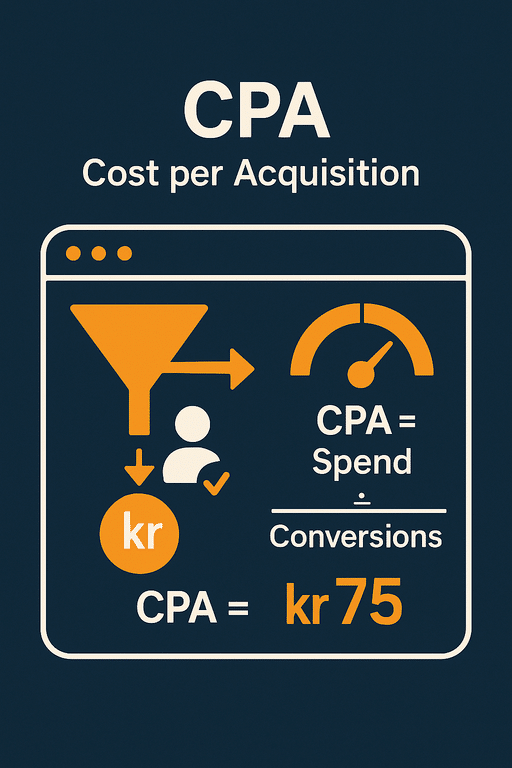
Here, the KPI CPA plays an important role because it provides a very concrete picture of what it costs to get a user to perform a desired action.
Whether it’s a sale, a sign-up, or a download, CPA helps make advertising more transparent and results-oriented.
But what does the concept actually cover? And how do you use it in practice?
What does CPA mean?
CPA stands for Cost Per Action or Cost Per Acquisition. It is a KPI and pricing model in online marketing where the advertiser only pays when a predetermined action – a “conversion” – is performed by a user.
It could be anything from a:
In some contexts, CPA is used to mean Cost Per Acquisition when “action” specifically refers to acquiring a customer, but fundamentally the model is the same.
Why is CPA important?
CPA makes advertising much more targeted because you only pay for actions that create real value for the business. This minimizes the waste of advertising budget on irrelevant clicks or impressions.
At the same time, the model provides a clear picture of ROI, as each action can be traced directly back to the campaign. This makes it easier to optimize efforts and prioritize the channels that actually deliver results.
Types of “actions”
The following are examples of the actions typically used as the basis for determining CPA:
Sale of a product (e-Commerce).
Filling out a contact or registration form.
Activate free trial.
Downloading an app or digital product.
How do you calculate CPA?
The basic formula is:

Example: If you spend 10,000 DKK on a campaign and 50 people perform the desired action (e.g. buy the product), then CPA = 10,000 / 50 = 200 DKK per action.
Advantages and disadvantages of the CPA model
Benefits
Less risk for the advertiser, as you only pay for impact.
Can provide high ROI if campaigns are well optimized.
Clear performance measurement, making it easier to analyze and adjust campaigns.
Disadvantages
The actions must be clearly defined and traceable; tracking problems can lead to errors.
Often higher cost per action than, for example, CPC, if the action is a sale, sign-up, or something with a high barrier.
Risk of low volume if the actions are too demanding or the target audience is too small.
When CPA is used
CPA is often used in:
Affiliate marketing, where partners (blogs, websites, influencers) promote a product and receive commission when actions are taken.
Lead generation (e.g. selling contact information) via ads or inbound marketing.
Performance marketing campaigns where the goal is direct response – sales, samples, sign-ups rather than just exposure.
Related concepts
Important considerations for optimization
Choose an action that fits your business goals but that users will realistically perform.
Ensure accurate tracking (pixel, verified leads, cookies, etc.).
Monitor CPA continuously and compare with Customer Lifetime Value (CLV) so you know how high a CPA you can accept.
Test different campaign variations to find the best channel, creative and target audience.
FAQ
When should you use the CPA model instead of, for example, CPC or CPM?
When the focus is on concrete results like sales, leads or signups, the model makes the most sense. You only pay when the desired action is taken, giving you full control over your costs.
This is particularly relevant in performance marketing campaigns, where the goal is not visibility alone, but measurable actions that can be linked directly to the bottom line.
How do you ensure that the actions are valid (e.g. avoiding spam or fake leads)?
Valid actions are ensured by setting clear criteria for what counts as a qualified conversion. This could be, for example, verified email addresses or fully completed forms. To do this, you should use reliable tracking tools and possibly automated validation so that fake leads or spam are filtered out before they are included in the analysis.
Can CPA be used for both B2B and B2C?
The model can be used in both segments, but the types of actions vary. In B2C, it is often purchases, downloads or newsletter signups, while B2B is typically about contact forms, requests or demo bookings.
What they have in common is that you only pay for actions that bring you closer to a specific business goal. This is regardless of whether the target group is businesses or consumers.
How do you set a realistic CPA target?
A realistic target is set by taking historical data and the customer’s lifetime value as a starting point. This provides a framework for how much you can pay per action and still ensure profit. The target should then be adjusted continuously through testing and optimization, so that the CPA always reflects both the market price level and the effectiveness of the campaign.