
Understanding popular Google searches not only provides important insights, but also opens up opportunities to streamline your marketing efforts via Google.
A few search terms attract a huge volume of users and represent a direct line to potential customers’ immediate interests and needs.
But what exactly characterizes these powerful keywords? How do you find them? And how do you best utilize their potential?
What are popular keywords in Google?
Popular keywords in Google are specific search terms (words or phrases) that have a high monthly search volume. This means that a large number of people regularly search for them in Google’s search engine.
Why are popular keywords important?
Popular keywords are important as their high search volume has the potential to drive massive web traffic. Gaining visibility on these terms either organically via SEO or paid via PPC can place your brand, product or message in front of a very large and relevant audience online.
In addition, analyzing popular keywords provides valuable insight into current market trends and broad user interests. This understanding of what engages many users is important for developing effective marketing strategies, creating relevant content, and remaining competitive.
How do I find popular keywords in Google?
You find popular keywords primarily using dedicated keyword tools. Google’s own free tools like Keyword Planner (requires Google Ads account), Search Console and Google Trends are good starting points for identifying keywords with high search volume. But also for examining their popularity over time.
There are also paid keyword tools (e.g. Ahrefs, SemRush, Moz, etc.) that you can use to research, analyze, and compare keyword data. You can use them to investigate which keywords your competitors are ranking high for or using in their advertising.
Also keep an eye on Google’s own features like “autocomplete” (search suggestions), “People also ask about” boxes, and related searches at the bottom of the results page for inspiration.
Types of keywords
Keywords can be categorized in several ways to better understand their potential and strategic use in marketing. A key distinction is often made between keyword popularity over time, where understanding the underlying search intent (the user’s purpose for the search) is crucial for effective targeting.

Evergreen keywords
Certain search terms reflect an ongoing interest or basic need among online users. These are characterized by a relatively constant and often high search volume month after month, without major seasonal fluctuations or sudden drops in popularity.
Other keywords, on the other hand, experience sudden or predictable spikes in popularity. Typically driven by current events, specific holidays, news coverage, or emerging cultural trends. Their search volume increases significantly for a limited period of time. It could be days, weeks, or months, after which they drop dramatically again.
Branded vs. Non-Branded Keywords
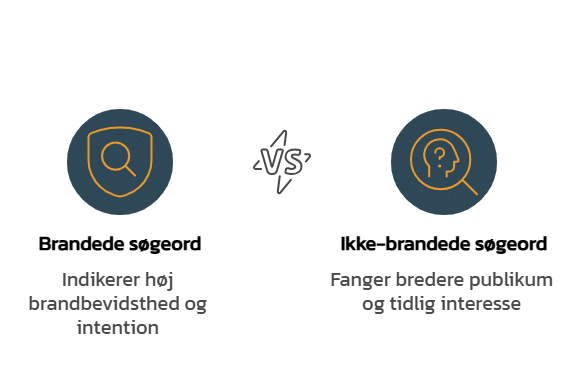
Another important distinction within keywords is between those that directly contain a specific brand name and those that describe a product, service, or topic more generally without brand references.
Branded
Branded keywords include the name of the company, product or service, possibly with variations or typical misspellings (e.g. “Lego bricks“, “Samsung TV“, “Google search“). Searches on these terms often indicate a high level of awareness of the brand. In addition, a strong intention to find or shop with that particular brand. This typically happens relatively late in the customer journey.
Non-branded
Non-branded (or generic) keywords, on the other hand, are terms that describe a category, problem, or need without mentioning a specific brand (e.g., “building blocks for kids,” “smart TV 55 inches,” “search engine“).
These are often used earlier in the customer journey during the research or consideration phase, where the user’s intent is broader and less locked into a specific brand.
Analyzing performance on both types is important for businesses. Branded searches reflect brand strength and loyalty, while non-branded searches show the potential to reach new customers and thereby gain market share from competitors.
Use of keywords in digital marketing
Understanding and strategically using keywords is fundamental across almost all digital marketing disciplines. They act as the link between users’ needs, expressed through their searches.
SEO (Search Engine Optimization)
Keywords are at the heart of SEO. They are actively used to optimize content on the website (on-page) and the underlying technical aspects (technical SEO). The goal is to match relevant searches, achieve better rankings in Google, and thus attract valuable organic traffic.
Content Marketing
Keyword research is an obvious tool for idea generation. By understanding what the target audience is actively searching for information about, companies can create highly relevant content. This can be blog posts, guides, videos, or other inbound marketing that directly addresses users’ needs and questions.
PPC (Pay-Per-Click Advertising)
In paid advertising platforms like Google Ads, keywords are essential for targeting. They determine where and when ads appear, inform bidding strategies, and are used to structure campaigns into logical ad groups.
Market analysis
Beyond direct campaign usage, keyword data (volume, trends, and related terms) provides insight into the market’s general interests, needs, and language usage. This understanding can inform everything from product development and positioning to overall communications strategy.
General considerations
While chasing popular, high-volume keywords can be tempting to drive more traffic, it’s not without its challenges. An effective keyword strategy isn’t just about choosing the most popular terms, but also about taking a realistic and targeted approach. It also requires you to assess which keywords have real business value for your business.
High competition
Very popular keywords are almost always subject to intense competition from many other players. This makes it significantly harder and slower to achieve good organic rankings (SEO). It also pushes up prices in paid advertising campaigns (PPC).
Cost (especially in PPC)
The high competition is directly reflected in the costs, especially in PPC platforms like Google Ads. The click prices (Cost-Per-Click, CPC) for the most sought-after keywords can be very high. This places great demands on the budget and can challenge a positive Return on Investment (ROI).
The importance of search intent
Perhaps the most critical factor. High search volume is worthless if the search intent behind the search doesn’t match the content, product, or service you offer. Attracting users with the wrong intent typically results in high bounce rates, low engagement, and ultimately wasted marketing dollars.
Risk of generic traffic
Broad, popular keywords (especially short-tail keywords) often attract a large amount of generic traffic. These may be users who are only in the early stages of research, looking for something a little different, or have no intention of converting at all. This type of traffic often has a low conversion rate.
The balance between popular and long-tail keywords
A healthy and effective strategy typically involves a balance between the different keywords. You shouldn’t focus solely on the broad “head terms.” The more specific “long-tail” keywords have lower individual volume, but often attract more targeted traffic with clearer intent and higher conversion potential.