
Have you ever wondered how ads seem to follow you around the internet?
It’s not magic, but the result of a smart and automated approach to digital advertising. This method, also known as programmatic marketing, is transforming the way companies buy and sell ad space.
It also ensures that messages reach the right target group at the right time.
What is programmatic marketing?
Programmatic marketing is the automated buying and selling of digital ad space using software and algorithms. Instead of manual negotiations, the process is lightning fast and automatic, often via real-time auctions (Real-Time Bidding – RTB).
This system uses data to identify and target ads to specific user segments across websites and apps, making advertising more effective and relevant.
How does programmatic marketing work?
The core of programmatic marketing is Real-Time Bidding (RTB), where ads are bought and sold in milliseconds while a website loads.
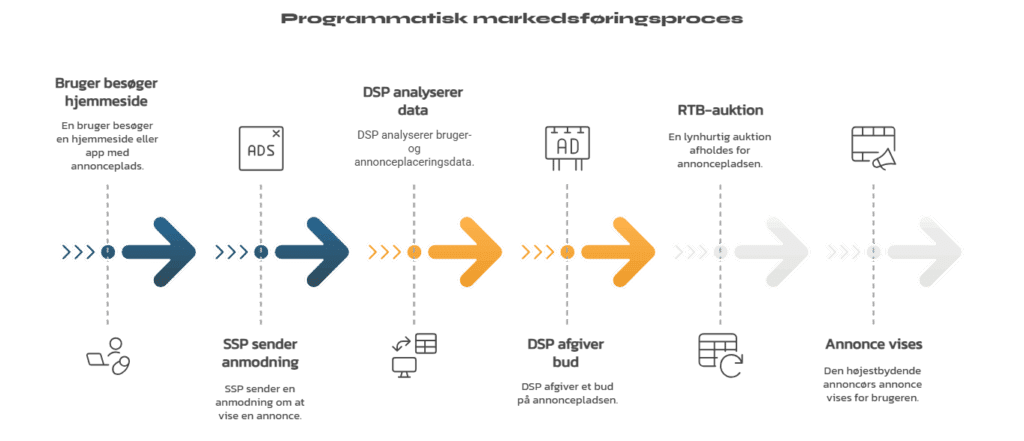
The process typically takes place via the following components:
- When a user visits a website or app with ad space, the publisher’s platform (Supply-Side Platform – SSP) sends out a request to display an ad.
- This request contains anonymized information about the user and the ad placement.
- The advertisers’ platforms (Demand-Side Platforms – DSP) receive the request and analyze the data.
- If the user matches an advertiser’s target audience, the DSP automatically places a bid for the ad space in a lightning-fast auction (Real-Time Bidding – RTB).
- The highest bidder’s ad wins and is displayed to the user instantly. The entire process takes only milliseconds.
Benefits of programmatic marketing
At the core of programmatic marketing is automated ad buying, driven by data and real-time insights. This approach ensures both high precision in targeting and high efficiency when delivering ads across digital platforms.
But that’s not all. Other benefits of programmatic marketing include:
- Efficiency: Automation minimizes manual work and ensures faster purchase of ad space.
- Scalability: Ability to run campaigns across many platforms simultaneously.
- Data-driven targeting: Advanced use of first-party and third-party data ensures precise segmentation.
- Real-time optimization: Continuous adjustment of bids and ad placements for maximum performance.
- Omnichannel option: Advertising across display, video, mobile, native and connected TV (CTV).
Challenges and considerations
Although programmatic advertising opens many doors, it also brings with it certain challenges and potential pitfalls that advertisers need to be aware of.
These include considerations about:
- Brand safety: There is a risk that ads will appear in contexts that are not consistent with the company’s values or image. This can damage the credibility of the brand.
- Ad fraud: Automation allows fraudsters to generate artificial clicks or impressions through bots, which can lead to wasted advertising budgets.
- Lack of transparency: The complexity of the programmatic ecosystem can make it difficult to gain insight into where and how ads are displayed, as well as which players are involved in the value chain.
- Lack of transparency: The complexity of the programmatic ecosystem can make it difficult to gain insight into where and how ads are displayed, as well as which players are involved in the value chain.
Where can you advertise programmatically?
Programmatic advertising can be used across virtually all digital platforms and touchpoints. It includes classic display and video ads on websites, targeted advertising on mobile phones, and direct advertising in apps. It also includes native formats that integrate naturally into content.
The technology also covers important and growing channels such as digital audio (podcasts, music streaming), Connected TV (Smart TV apps and streaming), and even digital outdoor displays (DOOH).
Below is a review of the most commonly used channels and formats within programmatic advertising:
Display
This is the most classic form of programmatic advertising. It involves the automated buying and selling of visual ad formats (banners, rectangles, etc.) on websites across the internet.
Programmatic ensures that these display ads can be targeted to specific users in real time based on data and context, significantly increasing relevance compared to traditional ad buying.
Video
Programmatic video advertising is growing rapidly. It involves buying video ad slots – such as pre-rolls (before content), mid-rolls (in the middle of content) and outstream (in articles outside a video player) on platforms like YouTube, news sites and streaming services.
It allows you to deliver captivating video messages to carefully selected segments with advanced metrics for visibility and engagement.
Mobil and In-App
As the majority of online activity now takes place on mobile devices, programmatic advertising on electronic devices such as smartphones and tablets has become indispensable. This includes both advertising on mobile-friendly websites and directly within mobile apps (in-app).
The formats are adapted to the smaller screen. They include everything from mobile banners and full-screen ads to interactive formats that take advantage of mobile features.
Native Advertising
Native ads are designed to blend naturally into the environment of the platform they are displayed on. This creates a less disruptive experience for the user. With programmatic native, these ads can be distributed efficiently and at scale across many different publishers.
The system automatically ensures that the ad design adapts to the layout of the individual page, while maintaining precise, data-driven targeting.
Digital Audio
The rise of music streaming services and podcasts has paved the way for programmatic audio advertising. Advertisers can now buy ad space in digital audio streams. For example, between songs on Spotify or as sponsorships within podcasts. Targeting can be based on the listener’s demographics, interests, music tastes, or even the time of listening.
Connected TV (CTV)
One of the most exciting and fastest growing areas, CTV includes advertising delivered via internet-connected televisions (Smart TVs) or devices connected to the TV (e.g. Apple TV, Chromecast, game consoles), typically in connection with streaming TV shows and movies.
Programmatic CTV combines the screen and high impact of television with the precision and data capabilities known from digital advertising.
Digital Out-of-Home (DOOH)
Even outdoor advertising is becoming programmatic. DOOH refers to digital screens placed in public spaces.
This could be about:
- Bus stops
- Train stations
- Shopping malls
- Airports etc.
Programmatic DOOH allows advertisers to buy space on digital outdoor displays more flexibly and in a targeted manner, where impressions can potentially be triggered by factors such as time of day, weather conditions or anonymized, real-time audience data.
Examples of platforms with programmatic marketing
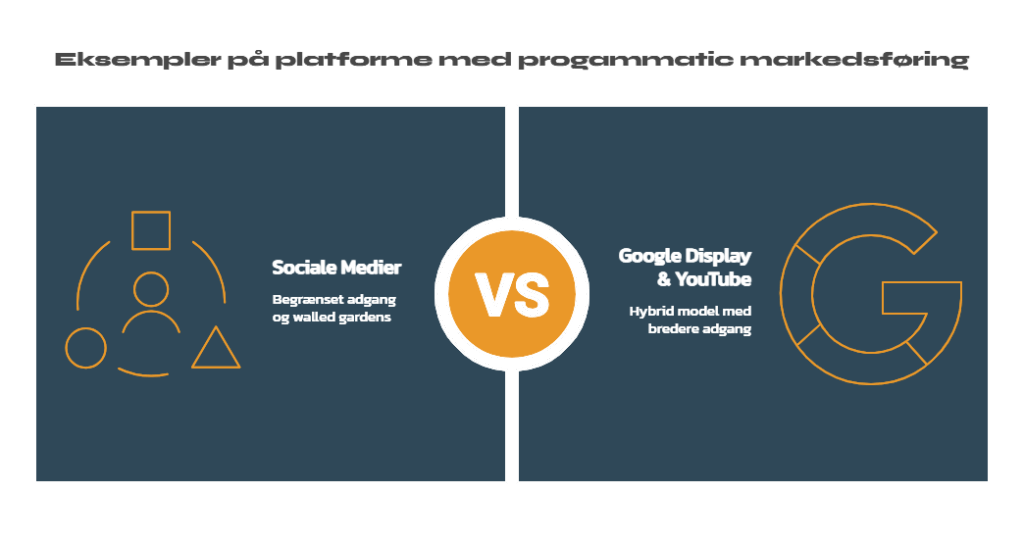
When looking at the programmatic marketing landscape, it’s important to understand how the big digital giants like social media and Google operate in relation to the broader ecosystem. While they use similar technological principles, access and integration vary significantly.
Social media
Social media platforms like Facebook, Instagram, LinkedIn, and TikTok have their own highly advanced and automated advertising systems. These systems rely on data, real-time bidding, and sophisticated targeting in ways that mirror the essence of programmatic.
However, they typically operate as “walled gardens“, i.e. closed ecosystems. This means that programmatic advertising on social media like these is almost exclusively done via the platforms’ own advertising tools (e.g. Facebook Ads Manager, etc.).
Standard Demand-Side Platforms (DSPs), which are used to buy across the open web, generally have very limited or no access to ad space on these social platforms, so they effectively act as separate buying channels, despite the technological similarities to programmatic.
Google Display & YouTube
For Google’s display and video inventory, primarily via the Google Display Network (GDN) and YouTube, the situation is a little different. Much of this inventory can be accessed programmatically via external DSPs.
This is because Google operates its own massive ad exchange (Google AdX), which many DSPs are integrated with, opening up purchases through this route. However, it is also possible to purchase the same inventory directly through Google’s own platform, Google Ads.
Google thus offers a more hybrid model with dual access, making their display and video advertising more intertwined with the general programmatic market than most social media.
Important concepts in programmatic marketing
Programmatic marketing has its own language full of acronyms and technical terms. Here’s an explanation of some of the most commonly used terms you’ll come across:
Ad Exchange
A digital marketplace where publishers (via SSPs) can offer ad space and advertisers (via DSPs) can buy it. Typically through real-time auctions (RTB). Acts as a neutral link between the buyer and seller sides.
Algorithm
A set of mathematical rules and instructions that software (e.g. in a DSP) uses to analyze data and make automated decisions. For example, whether to bid on an ad impression and what the price should be to achieve a certain goal.
CPM (Cost per mille / Price per thousand impressions)
A billing model where the advertiser pays a set price each time the ad has been displayed 1,000 times (Mille is Latin for thousand). A standard pricing model for purchasing ad impressions.
DMP (Data management platform)
A technology platform designed to collect, organize, analyze, and activate large amounts of data from various sources (first-, second-, and third-party data). Often used to create audience segments for programmatic campaigns.
DSP (Demand-Side Platform)
A software platform that advertisers and media agencies use to plan, buy, and manage ad space across multiple ad exchanges. It also includes SSPs through automated processes like RTB. It also provides access to ad inventory and targeting capabilities.
Impression
A single display of a digital ad on a user’s screen. When an ad loads on a web address or in an app, it counts as one impression. Basic unit of measurement for reach.
PMP (Private Marketplace)
A PMP is a closed, invitation-only auction environment where selected advertisers are given access to bid on specific ad space from a publisher, often premium inventory. This provides greater control and transparency compared to open real-time auctions (Open RTB).
RTB (Real-Time Bidding / Realtidsbud)
As a core technology in highly programmatic advertising, RTB refers to the lightning-fast, automated auction where ad space is bought and sold for a single impression in milliseconds. This is at the same time that a URL or app loads for the user.
SSP (Supply-Side Platform / Publisher Platform)
A software platform that digital publishers (owners of websites, apps, etc.) use to manage, optimize, and sell their ad space (inventory) automatically to potential buyers via ad exchanges. The goal is to maximize the publisher’s earnings.
Viewability (Visibility / Measurable Visibility)
A quality metric that indicates what percentage of an ad was actually visible on the user’s screen during a specific period of time. Industry standards (e.g. from the IAB) define minimum requirements for when an impression counts as ‘viewable’.
This glossary covers some of the most fundamental concepts in programmatic marketing, and can serve as a reference point for you as you navigate this ecosystem.