
Even the most well-written websites can struggle to gain visibility without the right connections. In SEO, external backlinks play a crucial role in how content is perceived by both users and search engines.
Dive into what exactly these valuable referrals are and why they are so important to your SEO strategy.
What are backlinks?
A backlink (also called an inbound link) is simply a hyperlink from one website to another. In search engine optimization (SEO), backlinks are crucial, as search engines like Google largely view them as digital recommendations or ‘votes’ on a page’s quality and relevance.
The more relevant, high-quality links your site receives from other trustworthy websites, the stronger it signals authority. This is often rewarded with better rankings in search results.
Why are backlinks important for SEO?
Backlinks act as recommendations in the digital ecosystem. Every time an external website links to your content, it is considered a vote of confidence by search engines. This means that both the quality and quantity of your backlinks have a direct impact on your SEO performance.
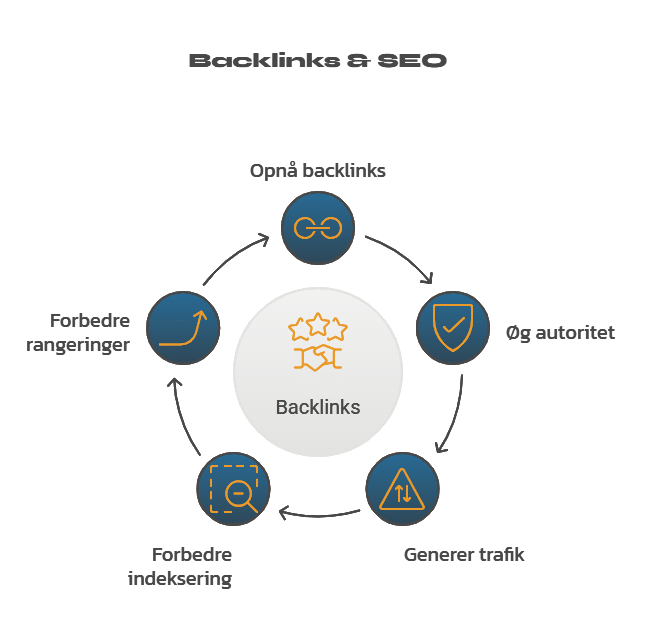
The quality and number of backlinks affect, among other things:
- Authority: Backlinks from trustworthy sites increase the domain’s authority.
- Traffic: Direct referral traffic from relevant sources.
- Indexing: Faster discovery and indexing of new content.
- Search rankings: Increased likelihood of ranking high on business-critical keywords.
However, it is important to note that not all backlinks are of equal value. Links from low-quality sites or spammy networks can harm your website’s SEO. In the worst case, they can trigger manual penalties from Google such as de-indexing and ranking demotions.
Types of backlinks
Backlinks are not the same, and they have different origins and thus different SEO value. Do you want to get to the top of Google? Or rank high on popular keywords in Google? Then it can be beneficial to understand these nuances to put you in a better position when you need to do a link analysis of the quality of both your own and your competitors’ link profile.
Different types of backlinks have different weight in an SEO strategy:
Natural backlinks
These are often considered the most valuable because they occur completely organically. This happens when other website owners find your content so good or relevant that they voluntarily link to it without any kind of influence or agreement.
Manually obtained backlinks
This type is the result of active and targeted link building efforts. For example, it can be links you obtain by contacting relevant websites and making them aware of valuable content, by writing guest posts on other platforms, or by entering into various types of content partnerships.
The method requires a strategic approach, outreach and typically strong content to offer.
Self-created backlinks
These are links that you actively create yourself by adding your web address in, for example, online link directories, in signatures on discussion forums, in comment fields on blogs or similar publicly available platforms.
These generally have lower value and should be used with care to avoid appearing as spam.
Approaches to acquiring backlinks
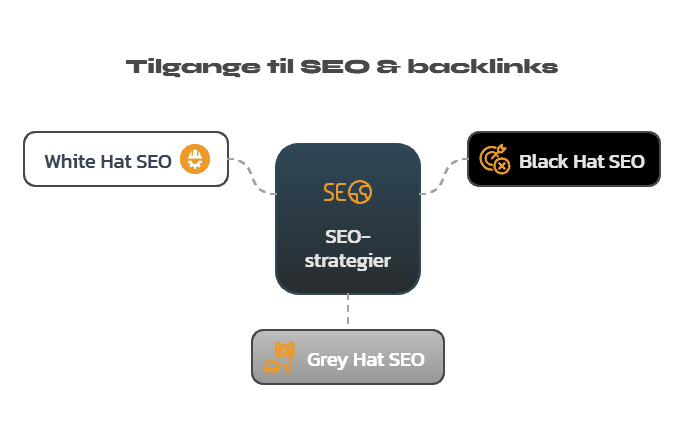
When it comes to link building, you come across a wide range of strategies and techniques. These are often categorized by “hat colors” (White, Grey, Black) to signal how closely they align with search engine guidelines and what risk they entail.
Which strategy is the best or ‘right’ depends on your situation and which tenant you are approaching.
White Hat SEO
This represents the ethical and recommended approach to SEO and link building. The focus is on creating value for users, adhering to search engine guidelines, and gaining links naturally through valuable content, genuine outreach, relationship building, digital PR, and a great user experience.
The goal is to create sustainable, long-term results.
Black Hat SEO
This covers aggressive tactics that directly violate search engine guidelines in an attempt to manipulate rankings. Examples include large-scale link buying/selling, keyword stuffing, cloaking (showing different content to users and search engines), and abuse of PBNs (Private Blog Networks).
Black Hat methods carry a higher risk of being penalized by search engines and should be avoided or used to a very limited extent.
Grey Hat SEO
These methods are in a gray area. They are not necessarily explicitly prohibited by the guidelines, but they can be perceived as manipulative. Or exploit technical loopholes in a way that goes against the intent of the guidelines.
Examples could be certain types of link exchanges, buying up expired domains solely for link juice, or excessive use of low-quality guest posts.
Although the risk is lower than with Black Hat, it is still present. The tactics can become problematic if search engine algorithms or guidelines change.
How is the quality of a backlink assessed?
Assessing the quality of a backlink is essentially about analyzing the source. Search engines like Google use complex algorithms to analyze a wide range of factors, both the link and the page it comes from, in order to determine its real value and impact on your rankings.
The most important factors for assessing backlink quality include:
- Domain authority: Age, a higher Domain Rating (DR) or Domain Authority (DA) are positive signals.
- Relevance: Backlinks from pages within the same industry or niche carry higher weight.
- Link placement: Links placed in the main content have greater value than links in the footer or comment fields.
- Anchor text: A natural and descriptive anchor text (also called link text) helps search engines understand what the page being linked to is about.
While the quality of individual links is important, it is ultimately the overall backlink profile that counts. A link profile is balanced and has a natural diversity of different link types and anchor texts. It is built over time with a focus on quality and relevance.
What is the difference between dofollow and nofollow backlinks?
A regular hyperlink is basically a dofollow link. This means that the link is considered an editorial recommendation that allows search engines to pass authority and value (often called “link juice”) to the URL being linked to. These links have the greatest potential to positively impact your rankings.
A nofollow link, on the other hand, has a specific HTML attribute (rel=”nofollow”) that signals to search engines that they should not pass link value or use the link in their ranking algorithms.
How quickly do you see the effect of backlinks on SEO?
There is no set timeframe for when backlinks affect SEO; the effect can vary from a few weeks to several months. The speed depends on factors such as the authority and relevance of the linking page, how quickly Google discovers and indexes the new link, the level of competition for the keywords you are targeting, and your own page’s existing authority and link profile.
Can too many backlinks harm my website?
Yes, a large number of backlinks can potentially harm your website, but it depends almost entirely on the quality and method of acquisition of the links, not the number per se. The problem arises if many of your links come from spammy or irrelevant sources.
Or if they were obtained through manipulative tactics that violate Google guidelines (e.g. hidden links, PBNs, or certain forms of link buying).
The path to a strong link profile
Backlinks are incredibly important to your website’s chances of being found on Google and other search engines. You can think of them as digital recommendations or votes. The more good and relevant “votes” your site gets from other trustworthy websites, the more authority and trust it signals.
This typically rewards search engines with better rankings.
One of the most important things to remember, however, is that it’s not just about having the most links possible. The quality and relevance of each link counts heavily. Likewise, the website’s link profile.