
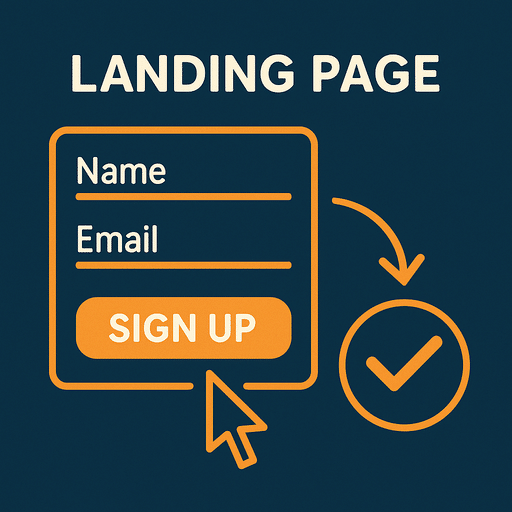
A landing page is a specifically designed web page that aims to convert visitors into leads or customers by getting them to take a specific action, such as filling out a form, signing up for a newsletter, downloading an e-book, or making a purchase. Landing pages differ from traditional website pages in that they are optimized for a simple, targeted action and a strong call-to-action (CTA), making them effective in a digital strategy.
Why is a landing page important in digital marketing?
Landing pages play a central role in digital strategies and are essential for campaigns in SEO, PPC (pay-per-click), email marketing and social media advertising. An effective landing page can significantly increase conversion rates by minimizing distractions and guiding the user towards a single action.
Advantages of a specific landing page include:
Improved conversion rate: Landing pages are targeted to a specific target audience and guide them in the best possible way to complete a desired action.
Targeted message: They are created with one primary purpose and use tailored messages to maintain attention.
Types of landing pages
There are several types of landing pages, each with specific purposes. The most common include:
Lead-capture: Designed to collect user data, such as name, email, and phone number, often in connection with offers of exclusive content like e-books or webinars.
Click-through: Typically used in e-commerce to direct the user directly to a product page or checkout page. This may be made specifically for a campaign and not the normal product page.
Sales: Often contains more detailed information about the product or service and aims to convince the user to make a purchase directly on the site or contact the company.
Elements of an effective landing page
A well-designed landing page can include the following elements, which can help increase conversion rates.
Compelling headline
The headline should immediately attract the user’s attention and clearly communicate the offer or value the page offers.
Subheading and supporting messages
A good subheadline complements the main headline and explains in more detail why the user should take action. This can be followed by supporting messages that provide more information about the benefits of the offer.
Call-to-Action (CTA)
The CTA is the most important element on a landing page. It can be buttons like “Download Now,” “Get Started,” “Sign Up Today,” etc. To maximize impact, the CTA should be visible, actionable, and easy to understand.
Good usability
The design should be simple and clean so that it doesn’t distract users from the CTA. The use of colors, images, and graphics should support the message and be consistent with the company’s brand. You can read more about conversion optimization here.
Social proof creates credibility
Reviews, case studies, logos from famous customers, and statistics help build user trust. Credibility is a critical factor, especially on sales landing pages where the customer needs to feel confident about making a transaction.
Lead capture or Sales form
If the purpose of the landing page is lead generation, there should be a form where the user can enter their contact information. The form should be short and only ask for necessary information.
Best Practices for Landing Pages
To maximize conversion rates and get the most out of a landing page, the following best practices should be considered:
Relevance and coherence: The page must be relevant to the ad or link the user clicked on, so it creates a natural transition and coherence.
Minimal distraction: Remove unnecessary navigation menus and links that can distract the user from the desired action.
Responsive design: Make sure the landing page works optimally on both mobile and desktop, as many users will visit the page from different devices.
A/B test: Test different versions of headlines, CTAs, images, and forms to find the combinations that result in the most conversions.
Simple and concise text: Be precise and specific, as too much information can seem overwhelming and scare the user away.
In a digital marketing strategy that typically uses multiple channels, landing pages serve as destination points for visitors who interact with ads or posts. For example, when using Google Ads or Meta Ads, it is crucial to direct users to a landing page that matches what they expected to find after clicking on the ad.
A landing page can also strengthen your SEO strategy if it is optimized with relevant keywords and internal links that match user intent. This can generate more organic traffic and improve the user experience by addressing specific user queries.
If you want to be successful with your digital strategy, you should consider whether there should be an increased focus on the design and development of landing pages for your advertising.