
When a business wants to grow, it’s not always just about buying attention with ads. There is also a more natural path forward, where things develop from within and over time.
Organic growth builds on what the company already does well – and makes it even better. When successful, it creates lasting growth without significantly increasing the marketing budget.
What is organic growth?
Organic growth is business expansion driven by internal resources and strategic initiatives, as opposed to growth through acquisitions (M&A) or paid advertising. In digital marketing, this growth is achieved by attracting and engaging target audiences through non-paid channels. Examples of this are typically SEO, content marketing, and organic visibility on social media.
Characteristics of organic growth
In digital marketing, organic growth is based on a clear and targeted strategy that aims to create lasting visibility in search engines and on the platforms where the target group is actively located.
In this regard, organic growth of characters most often occurs through:
- Strengthening existing products and services
- Expansion of the customer portfolio through digital channels
- Improving user experience and conversion rates
- Continuous optimization of internal processes and workflows
This type of growth requires that the company manages to create increased demand and improve its performance through its own marketing efforts. When this is successful, organic growth becomes a major driver for a more sustainable business model.
What is the difference between organic and inorganic growth?
In digital marketing, organic growth is about attracting customers naturally without direct advertising payments. This is typically done through SEO, valuable content, or organic activity on social media.
Inorganic growth, often referred to as paid growth, is achieved by paying for visibility and traffic through channels like Google Ads or PPC advertising on social platforms. This approach provides faster results and more control over targeting, but the effect typically stops when you stop paying.
Role in digital marketing
Organic growth generally plays a big role in digital marketing. It is especially relevant when working with channels where visibility and relationships are built over time. Many digital platforms and social media support this by having features for both organic reach and paid advertising.
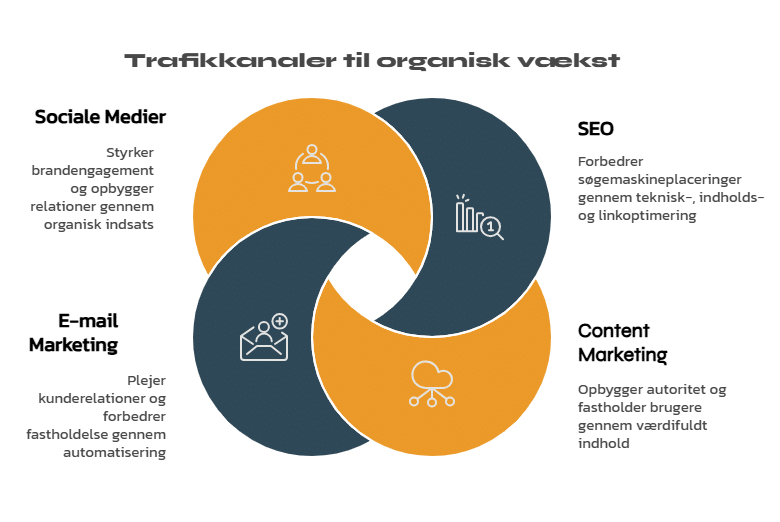
This is particularly expressed through the following channels:
Search engine optimization (SEO)
A classic example of an organic traffic channel is SEO. This channel is characterized by the fact that you strengthen your position in a search engine’s search results through targeted optimization of content, technical functionality and link building. For example, by searching for relevant and popular keywords in Google.
A successful effort leads to relevant and valuable traffic without you directly paying for individual visitors.
Content marketing
By producing valuable and targeted content, you can build authority within your niche and retain users throughout the customer journey, directly contributing to both traffic and conversions without the use of paid media.
E-mail marketing
By using automated and segmented email marketing, you can actively nurture customer relationships and improve customer lifetime value. As a growth channel, email is therefore particularly valuable, as it supports a strategy based on retention rather than solely new customer acquisition.
Sociale media
Although paid advertising is prevalent on social platforms (TikTok, YouTube, LinkedIn, Instagram, etc.), organic posting and active community building continue to create value. This organic effort strengthens your brand’s engagement and builds relationships with followers over time. As well as bringing new followers to your business.

Strategies to promote organic growth
To promote organic growth, you should focus on the following strategies:
- Develop data-driven marketing plans: Base your plans on insights into user behavior and current market trends.
- Test and optimize continuously: Conduct A/B tests and continuously optimize all digital touchpoints.
- Implement conversion optimization (CRO): Maximize the value of existing traffic through targeted CRO.
- Ensure internal collaboration: Establish close collaboration between marketing, sales, and customer service to guarantee a consistent customer experience.
Benefits of organic growth
As with any marketing strategy, there are both clear advantages and potential disadvantages associated with an organic approach.
Some of the biggest benefits are:
- Increased customer loyalty: Achieved through stronger customer relationships.
- Higher profit margins: The result of lower direct customer acquisition costs.
- Strengthened brand positioning: Contributes to increased credibility in the long term.
Disadvantages of organic growth strategies
As with all marketing efforts, there are also certain limitations/disadvantages to an organic approach. While the benefits are clear, it is important to be aware of the challenges that can affect results and timeframe.
Some of the typical disadvantages are:
- Slower results: It takes time to build visibility and trust without paid channels.
- Requires ongoing effort: Organic growth requires ongoing optimization and resources.
- Difficult to scale quickly: Organic strategies may be less flexible when needed for rapid growth.
Is organic growth better than paid growth?
It is rarely a question of whether organic growth is better than paid growth, as they serve different but often complementary purposes.
Organic growth builds long-term authority and customer relationships, while paid growth can deliver quick, controllable results right now. The choice therefore depends on your specific goals, timeframe, and resources.
In most cases, a combination of organic and paid growth yields the strongest overall results. Paid campaigns can generate immediate traffic and data that can inform the long-term organic strategy.
How long does it take to achieve organic growth?
Unfortunately, there is no set answer to how quickly organic growth occurs, as it is a long-term process. It depends a lot on the chosen platform/channel. You will typically see the first results after 3-6 months of consistent work with e.g. SEO and content marketing.
In more competitive niches, it can often take 6-12 months or longer before you start seeing results. Remember, it’s a marathon, not a sprint.
Find out how long SEO takes here.
How do I track organic growth?
Tracking organic growth is primarily done through web analytics tools like Google Analytics, where you isolate traffic from organic sources (‘Organic Search’). Here you can see the number of visits, user behavior and which pages perform best organically.
Google Search Console (GSC) is another important tool for tracking organic growth and click-through rates in Google search results. In addition to overall traffic, you should also track your rankings on important keywords via SEO tools like GSC.
When it comes to social media and email, engagement is an important factor. But the most important thing is to measure how many valuable actions, like leads or sales (conversions), can be attributed to your organic channels.