

For many companies, content marketing and copywriting have become an important core part of many strategic initiatives. Its results surpass many traditional marketing techniques, which is why it is considered by many in the marketing world as a renaissance.
But content is far from just content. Have you ever wondered how it can help you get more conversions or leads?
What is content marketing?
There are a number of different definitions of what content marketing is… To save you a lot of debate, content marketing can be understood as:
’A marketing strategy that focuses on creating valuable and relevant content for selected customer segments with the aim of capturing, retaining and creating long-term profitable relationships.’
Content marketing is thus inbound marketing in the form of strategic content, the purpose of which is to create customer relationships in the form of value-added content. It involves both organic and paid content, the latter of which concerns paid advertising/promotion of the content in question.
In this post, we will focus on organic text-based quality content (value-added content). However, the same factors also come into play when it comes to paid promotion of textual content.
Whether you are an SEO copywriter or work in content, you can benefit from the advice.
What does converting content entail?
As the name suggests, a converting text has the purpose of getting the reader to take a given action (e.g. sales, sign-ups, download lead magnets, etc.). This involves strategic efforts, customer data-driven and analytical approach to content production in your content marketing strategy.
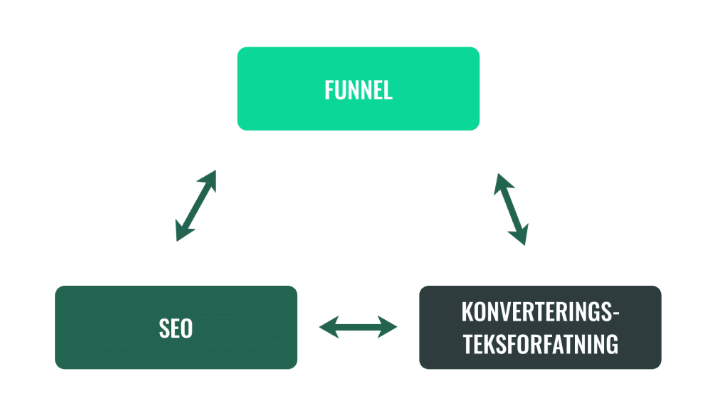
Quality content in a successful organic content marketing campaign broadly contains the following 3 elements:
-
- Funnel based approach (Top, mid, bottom)
-
- SEO-optimized content
-
- Conversion-focused copywriting
If you want to improve your existing content in relation to your KPIs and metrics, it is crucial that you actively work on the above points.
The Conversion Funnel – the Holy Grail
The philosophy behind content marketing is that content should follow a funnel. The funnel is used as an analogy for the ideal customer journey, where the potential customer goes from lead to customer.
The conversion funnel is typically used as a continuous analytical method to track leads as they move from one stage to the next in the funnel. The funnel provides an understanding of how familiar your leads are with your company’s products and services.
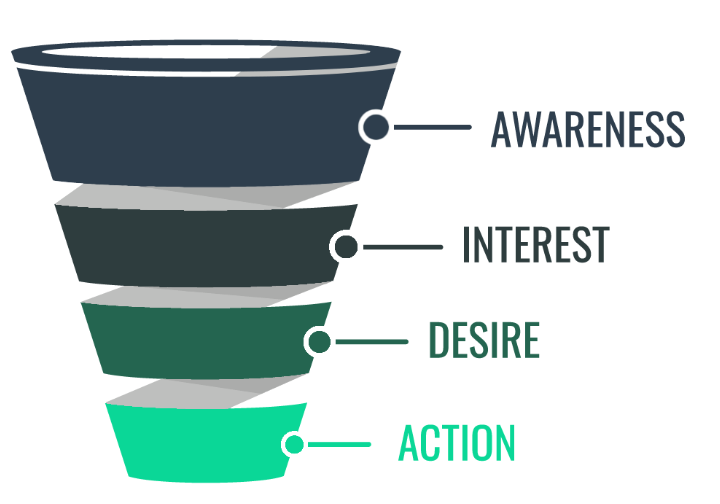
The stages of the conversion funnel provide insight and an idea of how to target your content to that lead. The goal is to move that lead to the next stage, because the further down the funnel your lead goes, the closer they are to converting. In the classic funnel, the customer journey is typically divided into the following stages:
-
- Awareness → Attention
-
- Interest
-
- Desire
-
- Action → conversion
The conversion funnel is typically divided into 3 main categories: Top, mid and bottom funnel. The top is made up of the ‘awareness’ phase, with the middle mainly comprising the ‘Interest’ and ‘desire’ phases. The bottom of the funnel focuses on the final phase, ‘action’.
Customer Retention
There are a number of modifications to the funnel, with some versions including subsequent phases such as Retention and Referral. It doesn’t always make sense to include both, but it can make good sense to actively work with ‘retention’.
According to Harvard, there is a meaning behind the madness…
Research conducted by Harvard points out that it is 5-25 times more expensive to acquire new customers than it is to retain your existing ones. Similarly, a 5% increase in customer retention can increase a company’s revenue by 25-95%. The aim is to improve actual customer relationships in order to increase loyalty.
That said, it’s important to always target and tailor your content to the different stages of the conversion funnel. This also includes investing in improving your current customer retention. Your leads’ behavior is different at each stage, so untargeted and wasted content can do more harm than good when it comes to the “maturation” of your lead.
But the funnel alone does not guarantee conversions, which leads us to the next point.
SEO – spotlighting your content
When it comes to content production for your content marketing strategy, it’s important to consider SEO. In short, it’s a data-driven approach that aims to optimize your content for visibility in search engines like Google.
SEO copywriting is an active ingredient in all organic quality content, as content doesn’t get found by itself, which is why it’s an absolute necessity. Because the more traffic you get, the greater the potential and your chances of capturing leads.
When you need to SEO-optimize your content, it is important that you actively work with the factors below, as they can maximize your SEO potential:
-
- On-page
-
- Structure
-
- ALL texts
-
- Linkbuilding
-
- Keyword analysis
-
- Search intent
Over the years, Google has placed an increased focus on quality content in their search engine results pages (SERPs), with their algorithm updates such as Panda, Hummingbird, RankBrain, and Penguin. Therefore, it is crucial that you not only create great content, but also SEO-optimize it.
Although SEO copywriting from a technical search engine perspective accounts for quality, it doesn’t tell us what converting content is for your leads. And, most importantly, how to create quality textual content.
Copywriting – The soul of your content
Not all texts are created equal, which is especially evident in content marketing. It is essential that your content meets the needs of search engines, but also your current and potential customers.
It’s one thing to write for search engines, but it’s another to write for your customer segments. This is where copywriting comes into play.
What is conversion copywriting?
Essentially, copywriting can be understood as many things, but basically it is the writing of persuasive and engaging texts with a specific purpose. This could be, for example, to sell goods and services, but also to take a specifically desired action.
You typically use text composition when you write:
-
- Newsletters for direct email marketing
-
- A blog post
-
- An article (like this one)
-
- The text of an advertisement
-
- Social media posts
The relationship between content marketing and converting copywriting
When it comes to content, there is a difference between how you write quality content for a newspaper, digital media, email, social media ads, etc.
Different communication platforms each have their own technical framework and way of communicating. There is a difference between communicating on a website versus email or a Twitter post and the like. There is also a difference in which audience you are communicating to. Why copywriting can be a whole science in itself…
But quality content without proper copywriting is wasted content in terms of ROI. Just like with SEO, where a text won’t be found on its own, content won’t be read or read enough if it isn’t engaging, attention-grabbing, looks good, and clearly calls to action.
And most importantly…
Answers the customer’s question: What do I get out of it?
This involves not only diligent use of the AIDA model, but also creativity and data.
The 5 foundations of a good converting text
There are many different ways to communicate a converting text. In many cases, it depends on the medium, the market, and the customer segment (reader) in question.
Overall, a converting text has the following anatomy:
-
- Get attention
-
- Show people a key benefit
-
- Prove this via. Social proof and data
-
- Create clarity and persuade people to understand the benefit
-
- Call to action
The above can be expressed in different ways depending on the medium of communication. However, it requires a thorough study of the customer segment in question and the market for your product/service.
A behavioral and data-based communication process
Like SEO, converting copywriting is an ongoing analysis phase with behavioral and data-driven communication. It is necessary to view the entire process under the same holistic analysis lens, where you continuously optimize the content against your metrics and KPIs.
To be successful with your copywriting, you therefore need to have insight into:
-
- Who your customer segment is
-
- Customer segment language
-
- Profiling archetypes
-
- Stage of awareness
-
- Customer decision-making style
-
- Their stage of knowledge of the product/service
-
- The emotions and the logic that drives them
Conversion copywriting is therefore as much about data and market research as it is about creatively manipulating words. Anyone can write about emotions, but without the right communication, data, and analysis, it’s a long way off.
You are not rewarded by your clients for a visually creative masterpiece, but rather for the value of your communication.
What does a converting text entail?
After you have collected the necessary data and knowledge, you should then adapt mass requests to your product/service, write and target the text, and continuously optimize your content for better results.
Conversional copywriting can therefore be seen as a circular process, the steps of which can be repeated up to several times. The number of steps depends on your hypotheses, research, testing and results.
Depending on the communication medium/platform, there will be different elements at play that can help you increase the conversion potential of your text.
This involves ongoing testing and optimization of the following:
-
- Use of power words
-
- Headings and subheadings
-
- The structure of the text
-
- Length of text
-
- CTA and its power
-
- Writing style and messages
-
- Lighting of advantages and disadvantages
-
- Data-backed claims
-
- Use of psychological tools
-
- Development of value propositions
-
- Social proof
-
- The use of emojis
-
- Use of direct response frameworks
-
- Personalization
-
- Segmentation
-
- Experiment and optimize
Quality, converting content is characterized by making extensive use of the above tools and elements. If you want your content to be as effective as possible, it is necessary that you actively work with them. The more of these there are in your text, the stronger and more effective a foundation it will have.
As Claude C. Hopkins, one of the godfathers of copywriting, once said:
”The more you tell the more you sell”
Converting copywriting is in many ways a whole science unto itself. In this post, we have only highlighted the tip of the iceberg, and a whole world of creative and computer-based writing is at your doorstep. We will continue to explore the professional goodies hidden in the lower layers.