

SEO is a constantly evolving discipline, and with the rapid development of artificial intelligence (AI), we are facing a new paradigm. Recent advances in generative AI such as ChatGPT from OpenAI have opened up new opportunities to leverage SEO in more innovative and effective ways.
Using advanced machine learning algorithms and natural language processing (NLP), these solutions can create authentic and human-like conversations. This is achieved through the use of personalized prompts and a deep understanding of the user’s needs.
To make the most of this technology in SEO, it is important to understand the basic concepts behind SEO prompts and generative AI. In this guide, we will primarily focus on ChatGPT prompts for SEO.
What is generative AI?
Generative AI is a type of artificial intelligence designed to create new content. It can be text, images, audio, video, or even code. Unlike traditional AI, which focuses primarily on analyzing and predicting data, generative AI goes a step further by generating something entirely new.
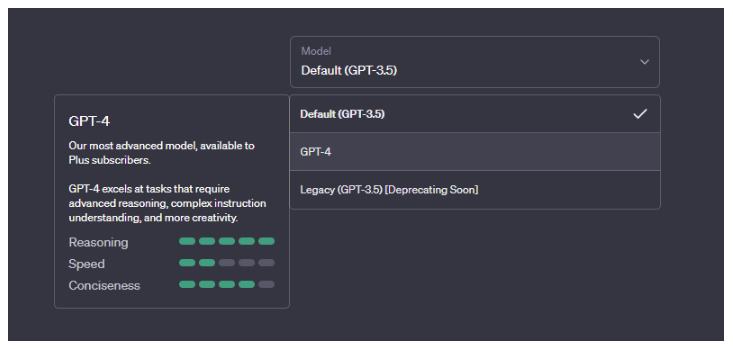
ChatGPT is a good example of this. It is based on the GPT-4 architecture and trained on a huge dataset of text from the internet, enabling it to generate coherent and relevant answers to various queries.
Other examples of relevant generative AI solutions range widely and include:
What are prompts?
Prompts can be understood as instructions or inputs given to a generative AI model in order to generate a specific output. You can think of a prompt as a starting command or a task description.
The quality of the prompt has a major impact on the quality and relevance of the output the AI generates, so it makes sense to adjust and refine your prompts.
By working more intelligently with your prompts, for example by using prompt frameworks and strategies you can better control and shape the result of the generated text or image you get.
What are prompt frameworks?
Prompt frameworks are structured methods or templates that help design more effective prompts. They provide a kind of “recipe” or set of guidelines that make it easier to formulate prompts that produce better and more consistent results.
Instead of improvising every time, frameworks provide an organized approach to prompt engineering.
SEO and Generative AI: A Perfect Synergy
While it may seem like SEO and generative AI are two different worlds, they are actually two sides of the same coin. They complement each other and when combined can create impressive results. As with any technology, the key to success is using the solutions to your advantage.
In the context of SEO, prompts are typically used to focus content production on specific keywords/topics to optimize the visibility of the text in search engines. You can quickly and cost-effectively create new content that can rank in Google like never before.
The possibilities are many and other uses range from:
- Analyze your current content from an SEO perspective
- Design an SEO strategy and action plan
- Outline a new information structure based on a topic
- Prepare a keyword analysis
- Write optimized meta data
- Do internal link building in blog posts
- And much more
💡 Proper use of prompts can be crucial to achieving success with generative AI and SEO, AI-SEO. Therefore, it is important that you use the right components when creating SEO prompts.
How to use SEO prompts in ChatGPT
Using SEO prompts for generative AI implies a strategic approach, whether you are using generative AI to create text-based or other content.
When specifying a prompt in ChatGPT, it is important to be precise and detailed in your wording. This will ensure that you get more relevant and useful responses. A prompt should be clear and unambiguous to give ChatGPT the best conditions to generate an appropriate response.
Consider including the following components in your prompt:
- Context
- Writing style, tone and voice
- Format (blog post, code, etc.)
- Command words (verbs)
- Audience
- Persona
- Any limitations
For example, you can specify whether the answer should be formal or informal, technical or understandable for a specific target audience, etc.
Context is key
Context plays an important role in formulating prompts in ChatGPT. It helps the AI understand the overall framework and purpose of the prompt. This leads to more accurate and relevant responses. When you include context in your prompt, such as the specific situation or audience you want to target, you give ChatGPT information that can guide its response.
Context is especially important because ChatGPT, while advanced, has no understanding of the real world or the subject matter necessarily. It bases its responses solely on the training data it has received and the instruction (prompt) it is given.
So by providing detailed context, you can guide ChatGPT towards the correct interpretation and use of the data it has available.
💡 A good rule of thumb is that ChatGPT is no better than the human behind it. Making it as precise and understandable as possible is crucial to getting useful results.
Follow-up prompts are your new friend
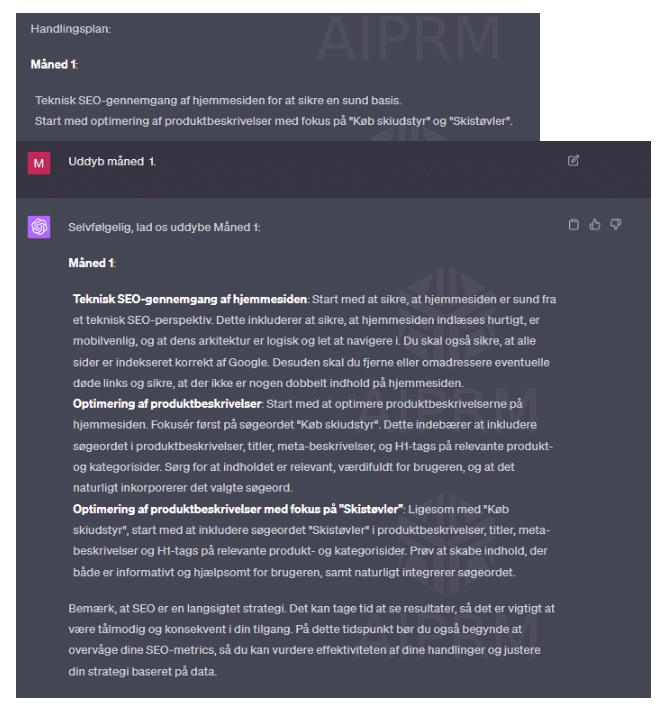
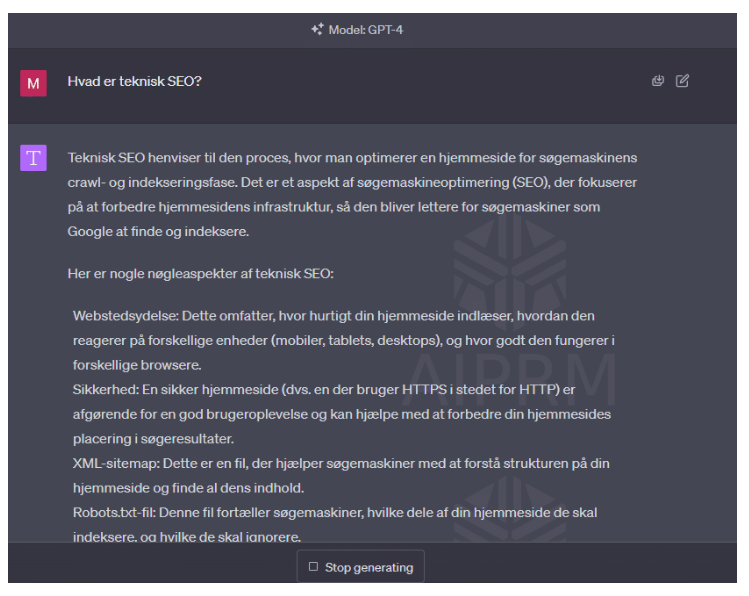
This type of prompt plays a crucial role when working with ChatGPT. These prompts allow you to delve deeper into the topic, clarify previous queries, or steer the conversation in a new direction.
In this way, follow-up prompts create an iterative dialogue that can lead to more detailed, precise, and relevant answers. They also serve as a means of fine-tuning and checking the response, especially in situations where the initial answer does not quite meet expectations.
Additionally, using follow-up prompts can help ChatGPT understand the deeper context or underlying intent behind your queries. This improves ChatGPT’s ability to generate more useful and targeted responses. Overall, follow-up prompts promote a more dynamic and meaningful interaction with ChatGPT.
Examples of follow-up prompts range from:
- Convert the response to a format: “Put in format [format]“
- Change order: “Arrange the contents in a different order“
- Translations: “Translate content into [language]“
- Video script: “Convert content into a video script“
- Formatting: “Use formatting, such as headings or lists, to make the content more visually appealing.“
- Elaborations:“Elaborate on the section [paragraph]“
Basic and advanced prompts
You typically distinguish between 2 different types of prompts when working with ChatGPT: Basic and advanced prompts. Which one you should go with depends on the context of your task and the approach.
Basic prompts
Typically, simple sentences, questions, or keywords are used to prompt ChatGPT to generate a response. For example, a basic prompt might be “Describe the solar system” or “How do you make pancakes?” These prompts are direct and simple, and they result in direct answers or simple text on the topic.
Basic prompts are quite useful when it comes to exploring a topic you don’t know much about, or getting quick answers to some questions.
Basic ChatGPT prompts for SEO can be:
- Create an FAQ: “What are the most common questions about [your topic]?“
- Explaining an SEO topic: “What is link building?“
- Find keywords: “Find 10 SEO keywords related to [your topic]“
- Content Ideas: “Make a list of potential content ideas on [your topic]“
Basic prompts are particularly useful for:
- Exploring a topic
- Provide direct, simple and quick answers
- Specific actions (Explain, describe, explain, etc.)
- Information search
- Quick help
Advanced prompts
A world apart are advanced prompts. In the AI-SEO world, they are also known as prompt frameworks, as you can reuse them as frameworks if they yield good results. Advanced prompts involve a deeper understanding and application of ChatGPT’s potential. They can include context, instructions on the format or style of the text, and other specifications that control the response from ChatGPT.
For example, an advanced prompt might be something like:
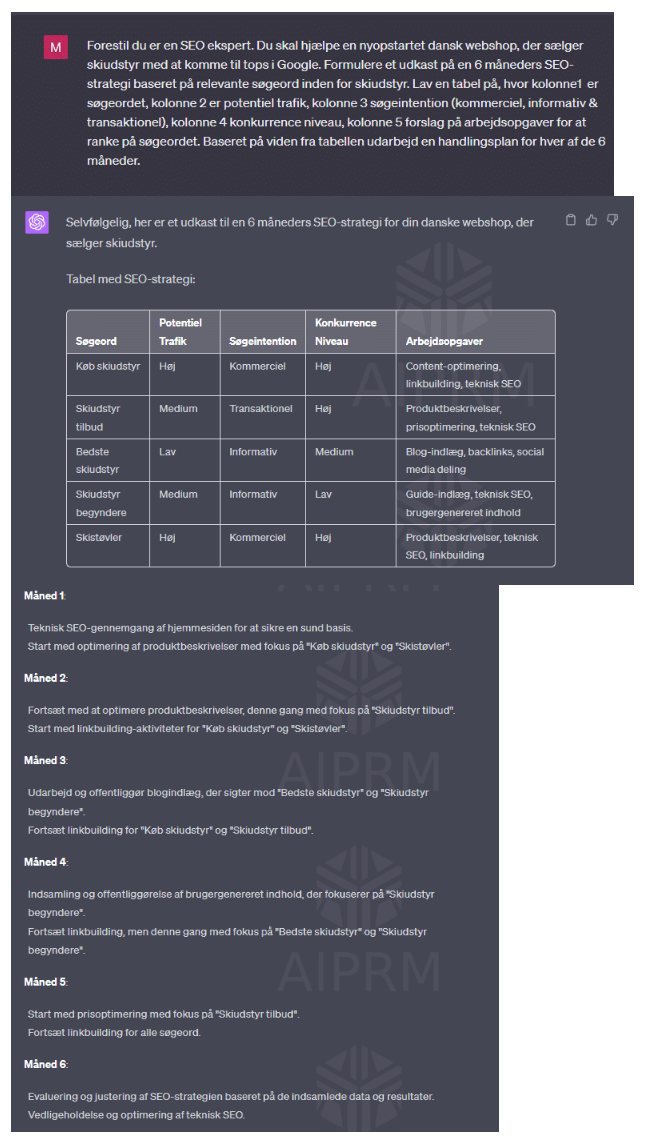
” Imagine you are an SEO expert. You need to help a newly launched Danish webshop that sells ski equipment get to the top of Google. Formulate a draft of a 6-month SEO strategy based on relevant keywords within ski equipment. Create a table where column 1 is the keyword, column 2 is potential traffic, column 3 search intent (commercial, informational & transactional), column 4 competition level, column 5 suggestions for work tasks to rank on the keyword. Based on the knowledge from the table, develop an action plan for each of the 6 months. “
The hallmark of advanced prompts is that they use and are composed of multiple basic prompts. They are very useful when you are dealing with a specific context. The syntax is not significantly different. You can think of advanced prompts as a layer cake🎂, where each layer is a relevant and supporting component to your prompt.
Advanced prompts are particularly useful for:
- Copywriting (optimized blog posts, email campaigns, landing pages, etc.)
- Analyses and reports (technical, on-page, off-page, etc.)
- Specific formats (e.g. creating an HTML markup for a product for a Shopify webshop)
- Go-to-SEO (Develop a holistic SEO strategy and action plan)
- Splittests (Helping to lay the foundation for an A/B split test)
- And much more
Advanced ChatGPT prompts for SEO can be:
- Classify search intent: “Classify search intent (commercial, transactional, informational, or navigational) for the following keywords in a table: [Your keywords]“
- Write blog posts: “Write a blog post with an introduction, body, and conclusion. The topic of the article is [your topic]. Use a friendly tone. The target audience of the article is [target group] who want [want/need]. Write the article in Danish and use correct Danish grammar. Do not use slang or made-up expressions and words. Use h1, h4, and h4 headings and bullet points as needed. “
- Do competitor analyses: “Using [specific metric], can you analyze [competitor name] and their [specific product/service] and provide insight into their [specific feature], [specific pricing strategy], and [specific customer experience element]? Specific competitor details: [competitor details] “
- Create a sitemap: “Can you generate a comprehensive sitemap for my [website type] website, which has [number of pages] pages and [content types/categories] content, while considering factors such as [specific SEO goal], [media types] media, and [specific user intent/behavior]?”
- On-page review: “Pretend you are an SEO specialist with 10 years of experience. Perform an On-page SEO audit of the following website <URL >“.
The list can be endlessly long, as you can truly set up and compose your prompts in countless ways according to your needs and purpose.
Ready-to-go prompt frameworks?
If you are looking for prompt frameworks that you can use right now, we recommend that you check out AIPRM for ChatGPT, HARPA AI and possibly FlowGPT.
12 best practices within prompts
- Provide as much relevant context as possible
- Be specific in your prompts
- Work on the structure of your prompts
- Define the format and use relevant language, tones, etc.
- Use a mix of basic and advanced prompts
- Make use of follow-up prompts as needed
- Modify your prompts according to your context
- Include reference sources
- Think of ChatGPT as a supplement and not a replacement
- Quality-assured and fact-check the results
- Experiment with your prompts continuously
- If you get a good response, remember to tell ChatGPT.
Is there a perfect prompt?
The short answer is: no, there is no prompt that works in all situations. It typically depends on the purpose of your prompt and the quality of the response. It can be very beneficial to lean on prompt frameworks and strategies within selected topics, but the best thing you can do is modify and play around with them yourself.
ChatGPT can come up with different results even if you use the same prompt. Just as Google continuously tests its SERPS, ChatGPT does the same with its algorithms. In addition, the answer can change depending on what you add or remove from your prompt. As such, there is no magic silver bullet that will give you 100% perfect results every time.
For example, don’t blindly believe that you’ll get top-notch optimized landing page copy that will both drive traffic and make your sales numbers explode, as if you had hired a top-notch SEO copywriter. Whether it will end up like that in the end is anyone’s guess.
“If you give a man a fish, he eats for a day. Teach him to fish, and he never goes hungry again.”
If the “perfect prompt” doesn’t exist or is a myth, why bother with generative AI at all? Even if the perfect prompt doesn’t exist, there’s still a lot of value in using generative AI technology like ChatGPT in your SEO work. There are significant time savings to be had and less grunt work to put up with.
You’ve probably heard the wisdom of learning to fish from a wise man named Lao Tzu. The same wisdom holds true in today’s world of generative AI prompts. You never know when you’ll find the perfect prompt on your way, but it’s all about the journey.
The more you work with your prompts, the greater the chances of better results.
The future of SEO work
To keep up with the constant evolution of digital marketing, it is important to understand and apply the latest technologies. Generative AI like ChatGPT gives us powerful tools to make our SEO work more effective.
By combining good SEO practices with ChatGPT’s ability to generate and analyze data, we can create content that is potentially both appealing to readers and visible to search engines. In the future, the integration of SEO and generative AI will likely become better.
We will see more intelligent solutions that can generate content that is not only SEO-friendly, but also creative, original, and tailored to the needs of the individual user. This opens up new possibilities for personalization and targeted marketing, which is key to success in the digital age.
🚀To make your SEO efforts as effective as possible, it’s important to not only focus on writing detailed prompts, but also on employing effective prompt strategies.